
Why some loads should not be switched directly
If you are wiring a smart relay into a real-world electrical system, the biggest mistake is assuming the relay can switch any load that fits on the label. In practice, the load matters as much as the current rating. Motors, pumps, compressors, and even some heaters can stress a relay in ways that are not obvious from the nameplate alone.
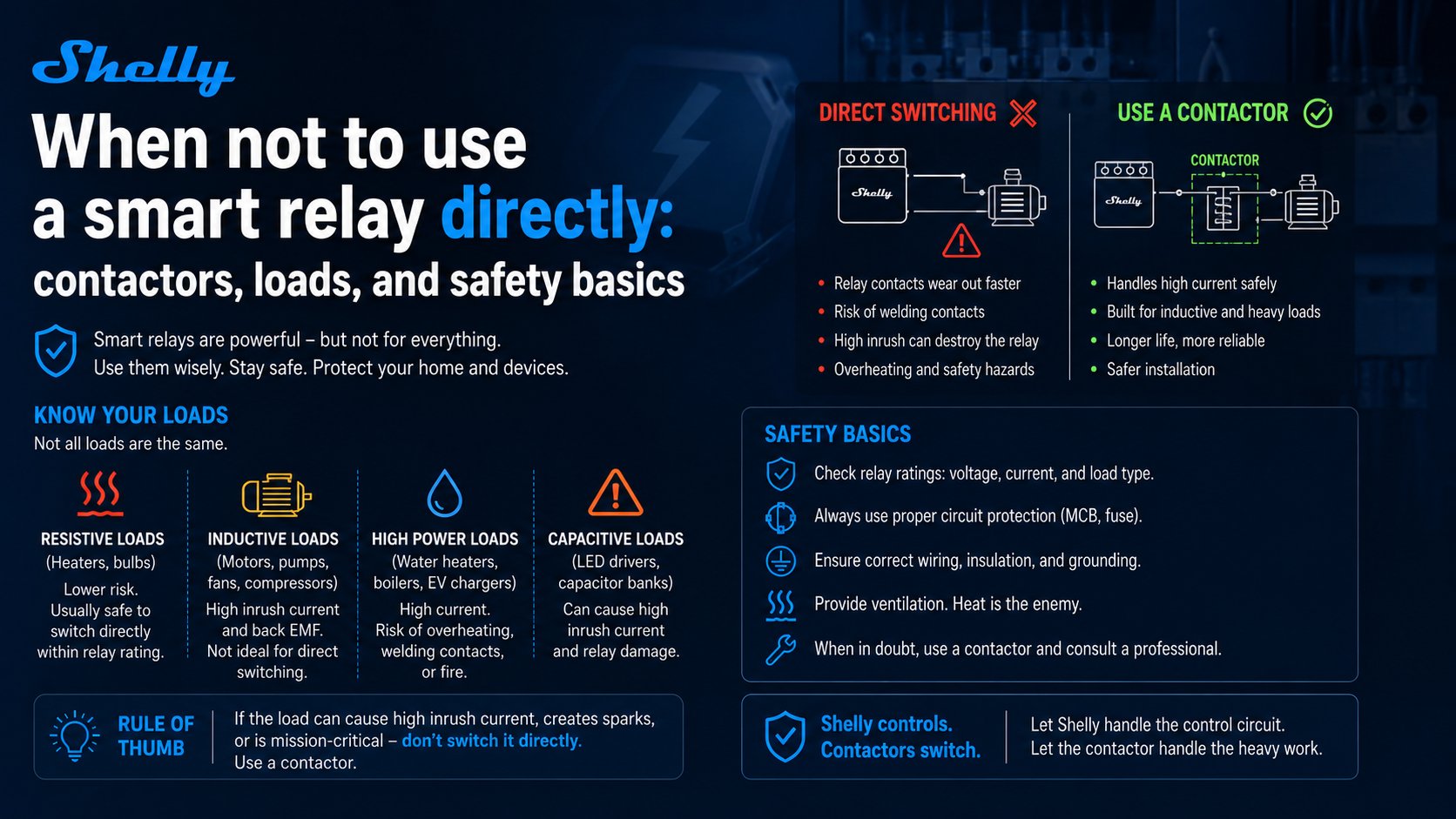
A safer way to think about a smart relay is this: it is often a control device, not a universal power switch. For heavier or more demanding equipment, the smart relay may be best used to control a contactor coil or another low-power input, while the contactor handles the main load. That distinction—control circuit vs power circuit—is the foundation of safer switching.
Relay ratings explained in plain language
A relay rating is a limit, not a suggestion. It tells you the kind of load the relay can switch, the voltage involved, and the maximum current it is designed to handle under specific conditions. But real installations rarely behave like neat datasheet examples. A relay that looks fine on paper may still be a poor choice if the load is inductive, switched often, enclosed in a warm cabinet, or run near its limit for long periods.
One important distinction is resistive versus inductive loading. A resistive load, like a simple heater element, draws current more predictably. An inductive load, like a motor or pump, can create voltage spikes and current surges when it starts or stops. That extra stress affects relay life and can increase the risk of contact wear, overheating, or nuisance failures.
Why motors, pumps, and compressors are difficult loads
Motor-driven equipment is the classic case where a smart relay should not automatically switch the load directly. The current shown on the label is usually the running current, but the starting current can be much higher. That surge is called inrush current. It is brief, but it can be large enough to cause relay contact stress every time the motor starts.
Pumps and compressors add another layer of difficulty because they are both electrical and mechanical loads. A pump that starts under pressure, a compressor that cycles frequently, or a motor that is lightly overloaded may draw more current than expected. If the rotor is stalled or the machine is starting under a heavy mechanical load, the current can remain elevated long enough to damage the switching device or trip protection. For this reason, motor and pump applications commonly use contactors and overload relays rather than relying on a small general-purpose relay alone.
A contactor is an electrically controlled switch used for switching a power circuit, typically with a coil and power contacts.
Heaters are simpler, but they still need proper protection
Heaters are usually resistive loads, so they are often easier to switch than motors. That does not mean every heater is safe to connect directly to a smart relay. A heater can draw high continuous current for long periods, and that sustained load can warm up relay contacts, terminals, enclosure components, and nearby conductors.
For heater circuits, the key questions are not only whether the relay can switch the current, but whether it can do so safely for the expected duty cycle, in the surrounding temperature, and with the correct conductor size and upstream protection. If the load is near the relay’s limit, or if the heater is fixed equipment in a demanding installation, a contactor or suitably rated switching device may be the safer choice.
When to use a contactor or motor starter
Use a contactor when the load is larger, switched frequently, or has a high inrush current. Contactors are designed for repeated switching of power circuits and are commonly used in motor control applications. In a typical setup, the smart relay energizes the contactor coil, and the contactor switches the heavy load.
If the load is a motor or pump, a proper motor starter may also include overload protection. Overload relays are designed to detect sustained overcurrent conditions that can overheat a motor. That matters because an MCB or fuse protects the circuit against overcurrent, but it is not the same thing as motor overload protection.
Control circuit vs power circuit: the safer pattern
The safest architecture is often to let the smart relay switch the control circuit rather than the power circuit. In plain English, that means the smart relay handles a low-power task—such as turning on a contactor coil, enabling a controller input, or triggering another low-current device—while the contactor or dedicated starter handles the actual load.
This approach reduces stress on the smart relay, improves switching life, and makes it easier to size the system properly. It is especially helpful when the load is inductive, when the installation is expected to cycle often, or when the equipment sits far above the relay’s comfortable operating range.
How to choose the right protection
Good switching design is not just about the relay. It is also about the protection around it. MCBs, fuses, and similar overcurrent devices are intended to protect circuits from overcurrent conditions, but they should be matched to the cable size, load type, and enclosure conditions. For motors, add overload protection where appropriate. For pumps and compressors, consider whether the system will start under load, cycle frequently, or operate in a damp environment.
Other practical points matter too: conductor sizing, terminal ratings, enclosure temperature, and IP rating all affect real-world safety. A relay that is technically within current limits may still be a poor choice if the cabinet runs warm or if the wiring is cramped and poorly ventilated. For installations in wet areas, outdoors, or dusty spaces, the enclosure and cable entry method should be suitable for the environment.
Shelly products in common safe-control roles
Some smart relays are well suited to control-circuit roles. For example, the Shelly 1 uses dry contacts, which makes it suitable for controlling an external circuit such as a contactor coil or another low-power input. The Shelly Pro 1 also provides a dry-contact relay output and is intended for DIN-rail installation.
For multi-channel control use cases, the Shelly Pro 4 can be used where several low-power control actions are needed. If you want to monitor energy rather than switch a heavy load, the Shelly Pro 3EM is a monitoring device and can measure energy use without being the primary load-switching device.
Products such as the Shelly 1PM combine switching and power monitoring, but monitoring does not make a relay suitable for every appliance. Always compare the device’s exact switching limits with the real load and the load type.
Practical decision checklist before wiring
- Is the load resistive, or is it a motor, pump, compressor, solenoid, or other inductive device?
- Does the load have a high starting current or frequent cycling?
- Are you switching the power circuit directly, or can the smart relay control a coil or low-power input instead?
- Is the relay rated for the exact voltage, AC/DC type, current, and duty cycle you need?
- Do you have the right upstream protection, conductor sizing, and enclosure for the environment?
- If the load is a motor or pump, is overload protection required as part of the design?
- If there is any uncertainty, should a contactor or licensed electrician be involved instead of a direct relay connection?
Common DIY mistakes with inductive loads
Several mistakes come up again and again. The first is assuming the nameplate current is the whole story. The second is treating a relay’s headline current number as a guarantee for every kind of load. The third is using a small relay to switch a motor or pump that should really be controlled through a contactor. Another common mistake is forgetting that protection devices are not load-switching devices. An MCB can help protect a circuit, but it does not turn an undersized relay into the right tool for the job.
DIY installers also underestimate enclosure heat, wiring quality, and the effect of repeated switching. If a load starts and stops many times a day, the relay sees more wear than a simple on/off use case. That is why frequent switching is one of the clearest signs that a contactor may be the better option.
When to stop and call a licensed electrician
If you are working on fixed wiring, unfamiliar mains systems, motors, pumps, heaters, or any installation where the load behavior is not completely clear, it is wise to stop and get qualified help. DIY electrical work can require caution and is not always appropriate for every situation.
The main rule is simple: use the smart relay directly only when the load is truly within its intended switching limits and the application is straightforward. When the load is inductive, high-current, frequently switched, or safety-critical, let the smart relay control the control circuit and let the proper contactor or starter handle the power circuit. That approach is safer, more durable, and usually easier to maintain.



Comments 0