
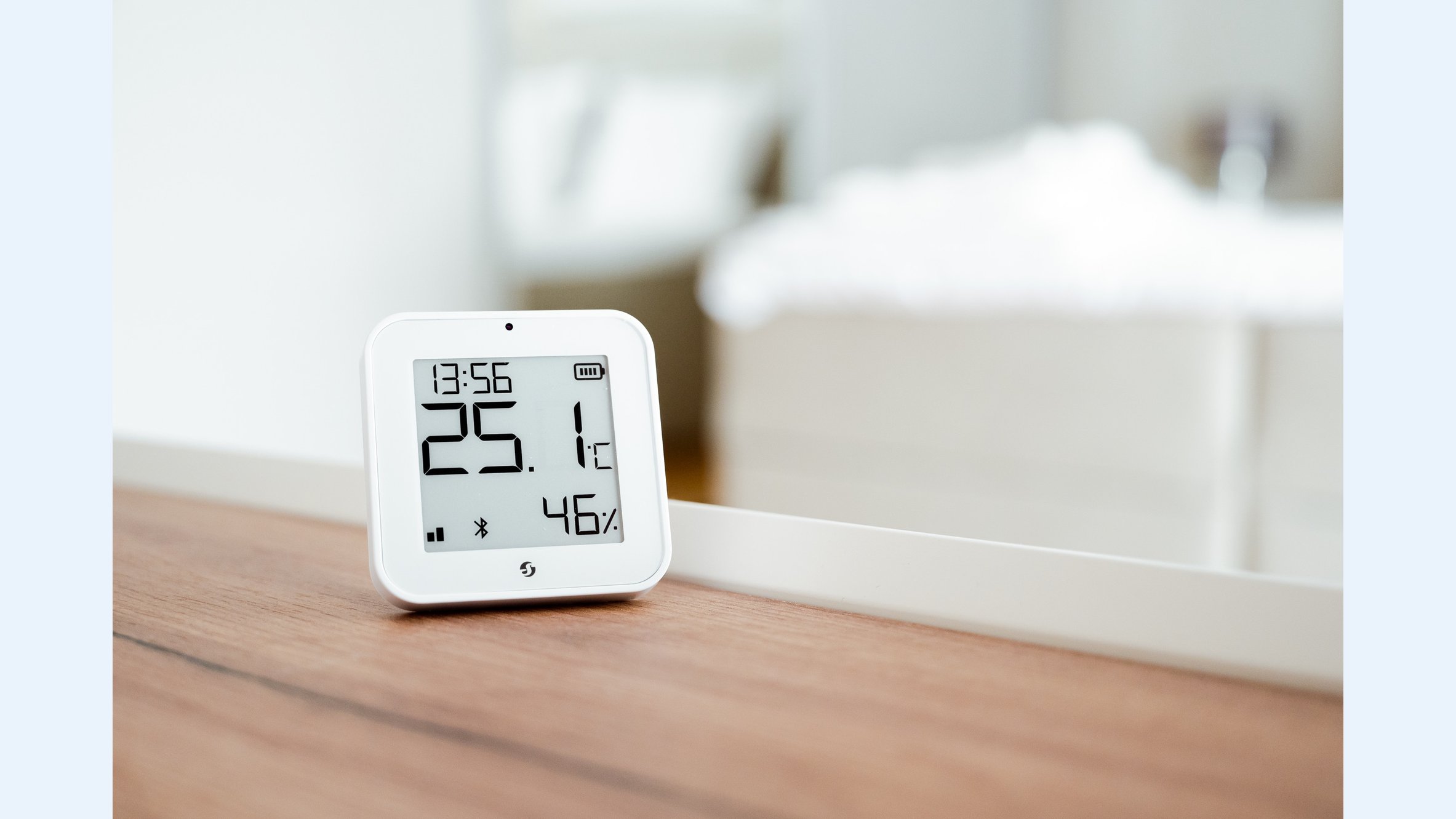
Bathroom Humidity: When Should You Turn On the Fan?
You step out of the shower, the mirror is fogged, and the bathroom feels warm and damp. You switch on the fan—or rely on a timer that will stop after a preset number of minutes. But how does the timer know whether the moisture has actually cleared?
That is the practical problem behind bathroom humidity. A fixed runtime can be useful, but it cannot see the room, the shower intensity, the outdoor conditions, or whether condensation is still forming. A measurement-based approach asks a better question: has the bathroom recovered from the moisture event?
Why Does Bathroom Humidity Rise So Quickly?
A shower adds warm water vapor to the air, while wet walls, floors, towels and shower curtains continue releasing moisture afterward. If the room is cool or air exchange is weak, that moisture remains in the bathroom for longer.
Humidity alone is not the whole condensation story. Condensation risk also depends on the temperature of the surface that moist air reaches: a cold mirror, window, external wall or ceiling can collect water sooner than warmer surfaces. The U.S. Environmental Protection Agency explains that condensation depends on both moisture in the air and surface temperature.
A short-lived rise during and after bathing is expected. The concern is when humidity stays elevated, surfaces remain wet, odors linger, or the room repeatedly returns to a damp baseline before the next shower.
What Is a Normal Bathroom Humidity Level?
Relative humidity describes how much moisture the air contains compared with the maximum it could hold at that temperature. Because warm air can hold more moisture than cool air, the same amount of water vapour can produce different relative-humidity readings as a room warms or cools.
The EPA recommends keeping indoor relative humidity below 60%, ideally between 30% and 50%. This is useful context for managing moisture, but it is not a universal bathroom-fan trigger. A bathroom may briefly rise above that range during a shower, and the appropriate response depends on the room, climate, ventilation system, surface temperatures and how quickly the reading returns toward its normal level.
Use the number as one signal alongside condensation, surface dampness, odors and the room's usual baseline—not as proof that a particular percentage guarantees a mold-free bathroom.
When Should You Turn On the Bathroom Fan?
Use the exhaust fan during moisture-producing activities and continue ventilation afterward. If the fan is part of a continuous ventilation system, ordinary operation may continue in the background while a higher boost setting handles the shower-related moisture load. Do not assume that a humidity sensor should replace a properly designed continuous system.
For any exhaust system, check that it actually discharges outdoors. The U.S. Department of Energy describes exhaust ventilation as removing air from a room such as a bathroom and discharging it outdoors. A fan that vents into a loft, wall cavity or other enclosed space can move the problem rather than remove it.
How Long Should a Bathroom Fan Run After a Shower?
There is no single runtime that fits every bathroom. Recovery depends on the fan's airflow, room volume, shower temperature and duration, the path for replacement air, outdoor conditions, surface temperatures and whether the duct is clear and correctly sized.
A short timer may be enough in a small room with a strong, well-installed fan. It may be inadequate after a long shower in a larger or colder bathroom. Conversely, a long fixed runtime may continue boosting after the room has recovered.
The most practical approach is to combine a minimum runtime or delay with a humidity or recovery condition. That way, the fan does not switch off immediately when the shower ends, but it also does not depend entirely on an arbitrary number of minutes.
Bathroom Fan Timer vs Humidity Sensor
Manual, timer-based, continuous and humidity-based approaches each solve a different part of the problem:
- Manual control: simple and inexpensive, but dependent on someone remembering to switch the fan on and off.
- Fixed timer: provides predictable operation after a trigger, but cannot tell whether a particular shower created more or less moisture than usual.
- Continuous ventilation with boost: maintains background air exchange and increases extraction when needed; its design and commissioning matter.
- Humidity-based control: responds to a measured condition, but depends on sensor placement, reporting behaviour, thresholds and compatible fan controls.
In practice, a combined strategy can be more robust: keep any required continuous ventilation enabled, use a boost command during or after bathing, apply a minimum runtime, and allow recovery conditions to end the boost. Residential ventilation guidance also distinguishes local bathroom exhaust from broader whole-home ventilation, so a local automation should not be treated as a replacement for the building's ventilation design. Consult current standards and local requirements through resources such as ASHRAE's standards and guidelines.
How Humidity-Controlled Ventilation Works
A simple humidity-based arrangement has four stages:
- Measure: a sensor observes temperature and relative humidity.
- Detect: an automation compares the reading with the bathroom's configured conditions.
- Ventilate: a compatible control increases extraction or sends a supported boost command.
- Recover: after a delay, minimum runtime and suitable humidity trend, the system returns to normal operation.
This arrangement is more informative than a timer alone, but it is not instantaneous or infallible. The sensor must observe a representative part of the room, communications must work, and the ventilation equipment must be capable of removing the moisture. A reading that changes slowly or is affected by its power mode and reporting configuration may not be suitable for very rapid control decisions; verify current behavior in the manufacturer's Shelly H&T documentation.
How to Automate Bathroom Ventilation with Shelly
Shelly H&T Gen3 can serve as the humidity-monitoring layer in a Shelly setup. It measures temperature and humidity; it does not remove moisture and it does not, by itself, switch or power a mains-powered bathroom fan.
The action layer must be a compatible relay, a supported fan input or another control arrangement appropriate for the ventilation equipment. A device such as Shelly 1 Gen4 may be relevant for some switching arrangements, but compatibility must be checked rather than assumed. The fan's electrical load, permanent-live requirements, control interface, speed settings, enclosure and local bathroom installation rules all matter. A power-monitoring relay does not make an incompatible fan compatible.
Within Shelly Smart Control, the sensor reading can be used as part of an automation or scene where the devices and configuration support that arrangement. Exact product capabilities, reporting behavior and installation constraints should be confirmed against current official documentation.
Why Use Separate On and Off Humidity Thresholds?
If a fan turns on at one humidity value and turns off at exactly the same value, small fluctuations can make it switch repeatedly. Using separate activation and recovery thresholds avoids this behavior. This is called hysteresis.
For example, an automation might start a boost when humidity rises clearly above the bathroom's established baseline, then stop only after the reading has fallen below a lower recovery condition and the minimum runtime has elapsed. Those values are illustrative, not universal recommendations. They should be calibrated to the room's normal readings, climate, fan capacity and ventilation design.
A delay, minimum runtime and trend check can also help. The goal is not to chase every percentage-point change, but to identify a genuine moisture event and confirm that the room is recovering.
Can a Bathroom Fan Turn On Automatically After a Shower?
Consider a typical sequence. Before bathing, the sensor records the bathroom's usual humidity. During the shower, the reading rises. Once the rise is large enough—or a configured condition is met—the automation requests a boost from the compatible ventilation control. The fan continues for the required minimum period and remains in boost while the recovery condition has not yet been met. When humidity falls toward the room's normal range, the system returns to ordinary operation.
This can reduce dependence on memory, but it does not promise instant activation. Sensor location, reporting intervals, network connectivity and the fan's own response all introduce delay. It also cannot compensate for a blocked duct, a weak fan or a bathroom that is receiving moisture from another source.
Where Should a Bathroom Humidity Sensor Be Placed?
Place the sensor where it can represent the room's general air conditions, not directly in the shower spray or immediately beside the fan outlet. Avoid locations exposed to splashing, extreme heat, direct steam jets, condensation dripping from a surface or strong drafts. A position with reasonable airflow and a clear view of the room is usually more useful than a hidden corner.
Follow the sensor's environmental limitations and installation guidance. Bathroom zones and electrical rules vary by jurisdiction, and a battery-powered sensor still needs appropriate placement. If you are unsure whether a location or control arrangement is permitted, ask a qualified installer.
Does Smart Ventilation Save Electricity?
It may reduce unnecessary boost operation when a fixed timer would keep running after the room has recovered, but energy savings are not guaranteed. A humidity-based system may also run longer after an unusually intense shower or in a slow-to-dry bathroom. Adequate moisture removal should take priority over a shorter runtime.
Measure the result through practical signs: fewer persistently fogged or wet surfaces, less lingering odor and a return toward the bathroom's usual humidity. Do not judge success solely by how quickly the fan switches off.
Can You Make an Existing Bathroom Fan Smart?
Sometimes, but the answer depends on the fan and the installation. Some fans use a straightforward switched supply; others require a permanent live, a separate trigger, a timer input, multiple speed controls or a proprietary interface. The device may also have electrical characteristics that are unsuitable for a particular relay.
Do not infer compatibility from the fact that a relay can switch a load in general. Have the fan model, wiring arrangement, relay ratings, enclosure requirements and local rules checked before installation. Work involving mains electricity and bathroom zones should be carried out by a qualified professional where required. This article intentionally does not provide wiring instructions.
When Is Smart Ventilation Not Enough?
Persistent dampness is not always a control problem. Investigate the building and the ventilation system if humidity remains high or condensation returns quickly. Possible causes include:
- A blocked, leaking or poorly routed exhaust duct
- Insufficient fan capacity or inadequate replacement-air paths
- Cold surfaces, poor insulation or thermal bridges
- Plumbing leaks, water ingress or moisture entering from another area
- Existing mold or material damage that requires separate assessment
The EPA's moisture-control guidance emphasizes that indoor activities, leaks, infiltration and other building sources all matter. The CDC likewise notes that mold grows where moisture is present and that controlling moisture is important. A sensor can identify a condition; it cannot repair a leak, clean damaged materials or redesign inadequate ventilation. For continuing problems, seek an assessment from an appropriate building, ventilation or plumbing professional.
The Practical Answer: Ventilate for Recovery
Turn on the bathroom fan during and after a shower, and make sure the exhaust actually reaches outdoors. A timer can provide a useful minimum period, but bathroom humidity varies from one moisture event to another. A humidity sensor can add context by showing whether the room is still recovering.
In a compatible setup, Shelly H&T Gen3 can provide the measurement layer while a suitable relay or supported fan input provides the action layer. Separate activation and recovery thresholds, delays and minimum runtimes can make the automation more stable. But the arrangement must be compatible, safely installed and supported by adequate continuous or local ventilation.
The central question is simple: not “How many minutes should the fan run?” but “Has the bathroom actually recovered?”
Bathroom Humidity FAQ
What is a normal bathroom humidity level?
The EPA recommends indoor relative humidity below 60%, ideally 30% to 50%. A bathroom can temporarily exceed that during a shower, so use the reading as context rather than a universal trigger.
When should the fan turn on?
Run it during bathing and afterward. In a humidity-based system, activate boost when humidity rises meaningfully above the room's established baseline, subject to a suitable minimum runtime and system design.
How long should the fan run after a shower?
It depends on airflow, room size, shower intensity, air paths, temperature and duct condition. Use a timer as a minimum or fallback, then allow measured recovery to determine when boost can end where the system supports it.
Should a bathroom fan run continuously?
If the building has continuous ventilation, do not disable it simply to rely on a humidity sensor. A boost mode can complement background ventilation, but the correct arrangement depends on the system's design and local requirements.
Can Shelly H&T Gen3 directly control a mains-powered fan?
No. Shelly H&T Gen3 is the monitoring layer. A compatible relay supported fan input or other suitable control device is needed for the action layer, and compatibility must be verified for the specific fan and installation.
Where should the humidity sensor go?
Place it in representative room air, away from direct shower spray, splashing, hot surfaces, condensation drips and strong drafts. Follow the product's environmental guidance and local bathroom installation rules.
What humidity thresholds should automation use?
There is no universal value. Calibrate activation and recovery conditions to the room's baseline, climate, surfaces, fan capacity and ventilation design. Use separate on and off thresholds to avoid rapid cycling, and verify the result by observing whether the bathroom actually dries.
Can automation prevent mold?
Automation may help manage one source of moisture, but it does not prevent or remediate mold by itself. Leaks, inadequate ventilation, cold surfaces and existing damp materials need separate attention. The CDC's mold guidance emphasizes the importance of controlling moisture.

Comments 0