
What Smart Lighting Without Replacing Switches Means
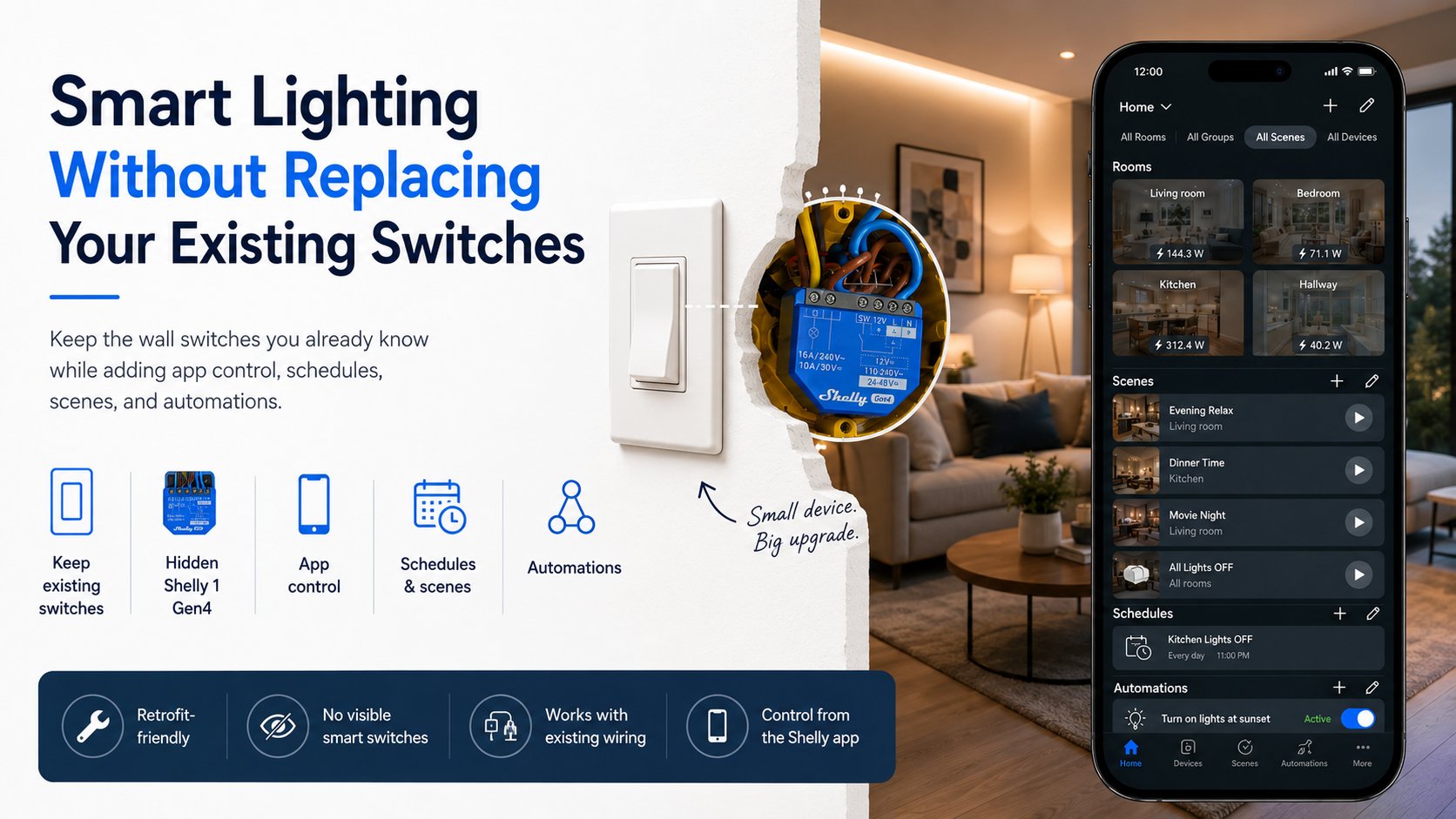
Smart lighting without replacing switches means adding intelligence to an existing lighting circuit while leaving the visible wall switch in place. Instead of changing the switch on the wall, a retrofit relay or dimmer is installed behind it or inside an electrical box so the light can still be controlled manually, but also by app, schedule, scene, or automation.
That hidden-module approach is appealing because it keeps the room looking familiar while adding modern control. For many homeowners, it is a cleaner retrofit than replacing every switch in the house, especially when the current switches already match the decor or when you want to avoid unnecessary disruption during a renovation. Shelly’s Shelly 1 Gen3 and Shelly Dimmer Gen3 are examples of compact modules designed for this kind of installation.
Why Keeping the Existing Wall Switches Is So Appealing
For a lot of homeowners, the biggest advantage of retrofit smart lighting is not the app features themselves. It is the fact that the room still works like a normal room. You flip the same switch you always have, guests know what to do, and you do not have to replace a full set of matching wall plates and switches just to get smart control.
This matters most in visible spaces where design consistency is important: hallways, living rooms, bedrooms, and kitchens. It also helps in older homes where switch styles may vary from room to room, or where replacing every switch would turn into a larger cosmetic project than expected. A hidden smart switch module gives you the benefits of automation without changing the look of the wall.
- The switch stays familiar for everyday use.
- The room keeps a cleaner, less visibly “smart” appearance.
- You can retrofit one circuit at a time instead of replacing every switch in the home.
- It is easier to keep a consistent look across rooms with different switch styles.
How Retrofit Relays and Dimmers Work
The basic idea is simple: the hidden device sits in the circuit and acts as the smart layer, while the wall switch remains the local control point. In a relay setup, the module turns the light on or off. In a dimmer setup, the module also adjusts brightness for compatible loads. Shelly describes the Shelly 1 Gen3 as a compact smart relay for installation behind wall switches or in electrical boxes, and the Shelly Dimmer Gen3 as a retrofit smart dimmer designed for installation behind existing switches.
That means the switch on the wall is not removed from the experience. Instead, it becomes one way to trigger the light locally, while the module adds remote control and automation features in the background. The exact wiring varies by device and circuit, so installation should always follow the product guide and your local electrical requirements. Shelly’s user guides explain switch input behavior and installation options in more detail for the Shelly 1 Gen3 and Shelly Dimmer Gen3.
“The switch remains in place as a local input, while the relay or dimmer adds app, schedule, and automation control in the circuit.”
What You Can Control
Once a light is connected to a smart relay or dimmer and linked to a smart home platform, the practical features go well beyond simple on/off control. You can set schedules so lights turn on or off at specific times, create scenes for different moods, and build automations that respond to motion, time of day, or other connected devices. Voice assistants can also be part of the setup when the device is integrated into the ecosystem. Google notes that connected lights can be controlled with voice commands and routines, while Apple supports home accessory control through Siri and automations within Apple Home.
For many people, the most useful part is not the novelty of turning on a light from a phone. It is the convenience of making everyday lighting behave more intelligently: a hallway that turns on when you walk through, a porch light that follows sunset, or bedroom lighting that dims automatically in the evening.
- App control from anywhere on the network or, when configured, remotely from outside the home.
- Schedules and timers for routine daily lighting.
- Scenes that combine lighting with other smart home actions.
- Automation triggers such as motion, sunrise, or sunset.
- Voice control through compatible smart home platforms.
Where Retrofit Modules Make the Most Sense
Retrofit smart lighting is especially useful in homes where you want the benefits of automation without a major visual change. It is a strong fit for rooms with standard switches that are used every day, especially when you want to keep the current trim, switch plates, and user habits intact. It is also practical when matching every visible switch in a home would be difficult because the house has mixed switch styles, older wiring, or several adjacent circuits in a multi-gang box.
Common use cases include hallways, bedrooms, kitchens, utility spaces, and renovated rooms where the finishes are already complete. In these situations, hidden modules offer a way to modernize the lighting while preserving the room’s appearance and avoiding a full switch replacement project.
Installation and Safety Considerations
Before buying any retrofit module, it is important to check a few basics. First, confirm that the device is compatible with the type of load you want to control. A relay is typically used for simple switching, while a dimmer must match the lamp type and dimming requirements. Second, check whether the wiring in the box provides what the device needs, including any neutral requirement. Third, make sure there is enough physical space behind the switch for the module, the wiring, and the switch itself.
Electrical DIY can be risky, and it is sensible to slow down whenever the setup is unfamiliar, crowded, or subject to local regulations. Guidance from Electrical Safety First notes that electrical DIY work can be dangerous and that qualified electricians should be used when the job is higher risk or required by local rules. If you are not confident working with mains wiring, hiring a licensed electrician is the safest option.
- Verify load compatibility before purchase.
- Check for neutral availability if the device needs one.
- Measure box depth and crowding behind the switch.
- Follow local electrical code and manufacturer instructions.
- Use a licensed electrician if the work is beyond your experience.
Retrofit Relays vs Smart Switches
Visible smart switches and hidden retrofit modules both bring connected control to lighting, but they solve slightly different problems. A smart switch replaces the wall control entirely, which can be straightforward if you want a uniform modern look and do not mind changing the hardware people touch every day. A hidden relay or dimmer keeps the existing switch, which is better when appearance, familiarity, or room-by-room consistency matters more than replacing the visible control.
There are tradeoffs. Smart switches can be easier to understand at a glance and may suit larger upgrades where you want everything to match. Retrofit modules can be more discreet and preserve the original user experience, but installation may be tighter because the electronics have to fit behind the switch or inside the box. In other words, the best choice depends on whether you care more about visible simplicity or hidden flexibility.
How to Choose the Right Device
The right retrofit device depends on the circuit, the room, and the control experience you want. Start with the switch type you already have and the kind of light you are controlling. If you only need on/off control, a relay may be enough. If you want dimming, choose a dimmer that is specifically compatible with the lamp type and installation conditions. Then check practical details such as load rating, required wiring, available space, and connectivity options.
If you want scenes and automations, make sure the device supports the platform or integrations you plan to use. If you want to keep existing wall switches smart in a way that still feels natural to other people in the house, choose a module with clear local switch behavior and a setup that matches how the room is actually used. The best retrofit smart lighting setup is the one that fits the circuit cleanly and disappears into daily life.
The Bottom Line
Smart lighting without replacing switches is a practical retrofit path for people who want modern control without changing the look or feel of the home. Hidden relays and dimmers let you keep familiar wall switches while adding app control, schedules, scenes, and automation in the background. For many homeowners, that combination of minimal visual change and useful smart features is exactly the point.
Shelly’s compact relay and dimmer modules are examples of how this approach works in real homes, but the same decision-making applies broadly: check compatibility, respect safety limits, and choose the option that fits the room rather than forcing every circuit into the same solution. In the right setting, retrofit smart lighting can be the least visible way to make a home feel more connected.


Comments 0